
California Medical Malpractice and Wrongful Death Damage Caps for 2026
March 25, 2026 | Article by Chain | Cohn | Clark staff Social Share

For fifty years, California law capped what could legally be recovered for pain and suffering in a medical malpractice case at $250,000, a number set in 1975 and left untouched for decades. Assembly Bill 35 (AB 35) finally changed that. Here’s what the new limits mean for victims of medical malpractice and their families in 2026 and beyond.
Why Assembly Bill 35 Matters to California Injury Victims
AB 35, signed by Governor Newsom and effective January 1, 2023, replaced the flat $250,000 cap imposed by MICRA with two higher limits that increase automatically each year.
When the law took effect in 2023, the starting limits were $350,000 for injury cases and $500,000 for wrongful death. Those numbers will climb every January until they peak in 2034 at $750,000 for injury cases and $1,000,000 for wrongful death, after which annual inflation adjustments continue.
One detail worth knowing: the cap that applies to your case is the one in effect when the claim is resolved, not when the injury happened or the lawsuit was filed. That means the longer a complex case takes to litigate, the higher the available ceiling may be.
How Much Can I Collect in Damages in 2026?
The current non-economic damage limits for cases resolved this year are:
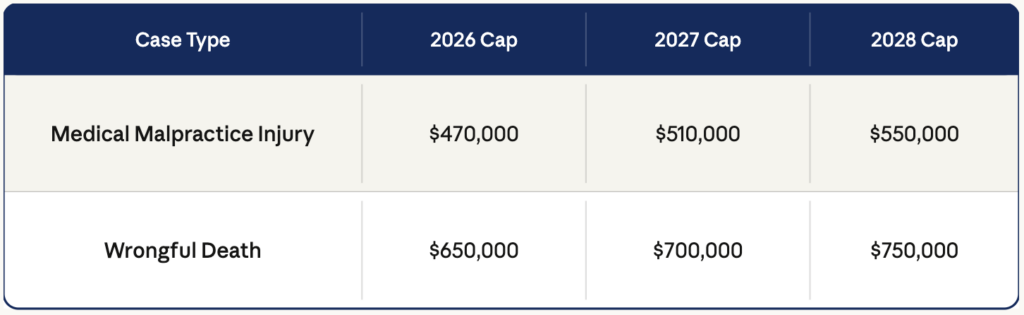
These caps apply to non-economic damages: things like pain and suffering, emotional distress, loss of enjoyment of life, and loss of companionship in wrongful death cases.
Economic damages (medical bills, rehabilitation costs, lost income) remain completely uncapped under California law. For victims with catastrophic injuries requiring lifelong care, those figures can dwarf the non-economic limits entirely.
“Stacking” Can Multiply the Recovery Further
Here’s where AB 35 gets especially significant for complex cases. When more than one type of defendant shares responsibility for a patient’s harm, the cap can apply separately to each. This is called stacking, and it can dramatically increase your total recovery.
Under the law, separate caps may apply to three distinct defendant categories: a healthcare provider (such as a surgeon), a healthcare institution (such as a hospital), and an unaffiliated provider or facility. Each must be shown to have acted negligently on their own.
To put that in concrete terms: if a hospital, a surgeon, and an independent anesthesiologist were all found negligent in a 2026 case, the non-economic damages could reach $470,000 × 3, for a total of $1.41 million. In a wrongful death case resolved in 2028, the same scenario could yield $750,000 × 3, or $2.25 million.
This provision reflects something the old law overlooked entirely: serious medical errors rarely have just one cause.
A Long-Overdue Update to California Medical Malpractice Law
AB 35 is the most significant reform to California’s medical malpractice framework in decades. Rising caps, uncapped economic damages, and the stacking provision together create a landscape where serious cases can result in recoveries that actually reflect what victims have lost.
If you or someone you love has been harmed by medical negligence, understanding how these rules apply to your specific situation is the first step. Our attorneys will investigate what happened, identify every responsible party, and pursue the full compensation available, including cap increases and stacking where they apply. Contact Chain | Cohn | Clark for a free case review. You can also learn more about how California’s wrongful death laws interact with these new limits, or speak with one of our Bakersfield personal injury lawyers today.
Kern County Wrongful Death Lawyer Services
Find trusted legal representation near you. Click your city below to learn more.

