
Defective Product Burn Injuries: California Legal Rights
August 4, 2026 | Article by Chain | Cohn | Clark staff Social Share

A defective product burn injury occurs when a consumer product overheats, ignites, or explodes, and causes burns to the person using it. Under California product liability law, the company that designed, manufactured, or sold the product can be held liable. The injured person does not need to prove negligence, only that the product was defective and that that defect caused their injury. This guide explains how these consumer product injury claims work, which products most often cause serious burns, and what evidence is necessary to prove liability in cases like these.
Which Defective Products Cause the Most Serious Burns
Some product categories show up repeatedly in burn cases because of how they store or generate energy. Lithium-ion batteries are the most common example. They pack a large amount of energy into a small cell, and when that cell is poorly made or damaged, it can enter thermal runaway: a rapid, self-feeding, overheating process that can end in a fire or a small explosion. Phones, laptops, e-cigarettes, power banks, and e-bike batteries all rely on these cells.
Household appliances are another common cause. Space heaters that lack proper tip-over shutoffs, coffee makers with faulty wiring, and pressure cookers that release scalding contents under pressure have all led to serious burn claims.
The commonality between these causes is, in each case, a defect. A burn or other injury is caused by a specific failure in how the product was designed or built, not by misuse.
Lithium Battery Fires and E-Cigarette Explosions
As lithium batteries have come to power a growing share of everyday devices, from phones to e-bikes, the Consumer Product Safety Commission has identified their fire and burn risk as a growing safety concern, and clear legal information for the people they injure remains hard to find. When a lithium cell fails, it can vent flammable gas, ignite, and burn at extreme temperatures within seconds. E-cigarette and vape pen explosions have caused facial burns, hand injuries, and thigh burns when a device ignited in a pocket.
Liability attaches in these cases because the failure is rarely random. A cell that enters thermal runaway usually did so because of a manufacturing flaw, a design that provided no thermal protection, or a charger that delivered the wrong voltage. Each of these points to a company in the chain of distribution, from the cell manufacturer to the brand that assembled and sold the finished device.
Proving a Defective Product Caused a Burn
California recognizes three theories of product liability: a manufacturing defect, a design defect, and a failure to warn. A manufacturing defect exists when a specific unit is created with an unintentional flaw, unlike the rest of its product line. A design defect exists when an entire product line is unreasonably dangerous even when built correctly. A failure to warn exists when a company does not disclose a known risk or provide adequate instructions for safe use.
Product liability claims in California are governed by strict liability. Under a strict liability theory, an injured person does not need to prove that the manufacturer was negligent; they only need to prove that the product was defective, that the defect existed when it left the manufacturer’s control, and that the defect caused the injury. This standard exists because manufacturers, not consumers, are best positioned to identify and prevent dangerous defects before a product reaches the public.
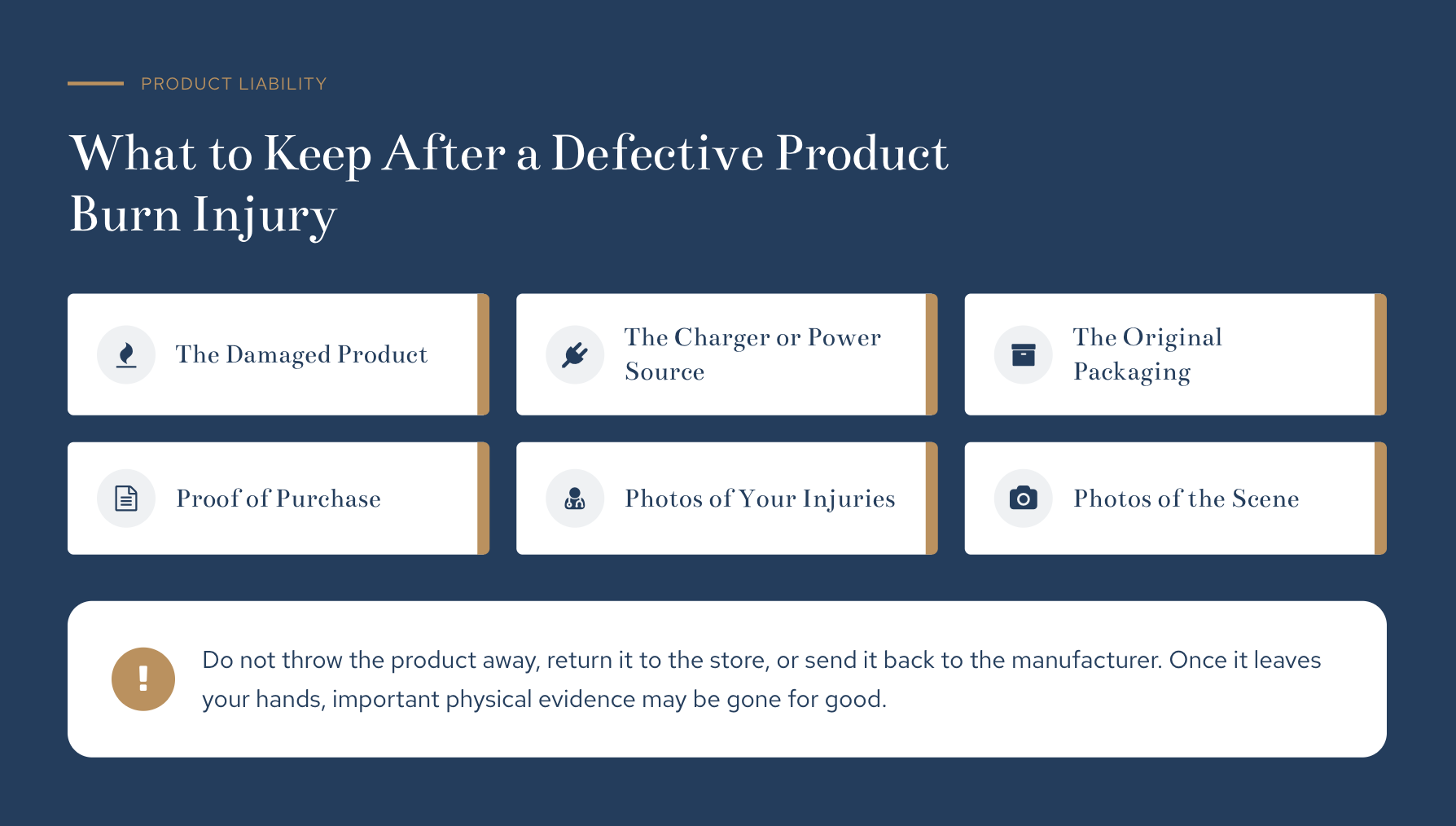
Preserving the product is the single most important step available to an injured person. The burned device, its charger, the packaging, and any purchase records (e.g., receipts) are what form the physical backbone of a claim. Photographs of the injury and the scene are useful, but the product itself is the evidence on which expert analysis depends.
Recalled Products and Known Defects as Evidence
A recall can support a claim, though it does not establish liability on its own. When the Consumer Product Safety Commission (CPSC) or a manufacturer recalls a product, that record independently confirms the product had a defect, and it can help identify the specific hazard and the units affected. Whether a recall also helps establish what a company knew, and when, depends on the other evidence in the case. The CPSC maintains a database of product recalls that can be used to see if a recall exists for a specific product.
A recall issued after an injury does not bar a claim, and a product that was never recalled can still be defective. A recall is one piece of proof among several. How it can be used as evidence, particularly when a recall is issued after an injury, should be discussed with an attorney.
Frequently Asked Questions About Defective Product Burn Injuries
Yes. If a defective product caused your burn, California strict liability law allows you to pursue the manufacturer, and often others in the distribution chain, without needing to prove the company was negligent.
You may still have a claim. A prior recall can actually help your case, because it independently confirms the product had a defect. The key questions are whether you received effective notice of the recall and whether the defect that prompted the recall was what caused your specific injury. An attorney can assess how a recall affects your specific situation.
Keep it. Do not repair or alter it. The damaged product, its charger or power source, the packaging, and your proof of purchase (e.g., receipts) are central evidence. Store the item safely and photograph your injuries and the scene. Preserving the product often makes the difference in proving what failed.
California’s statute of limitations for personal injury is generally two years from the date of injury. Certain circumstances can change that timeline, so it is wise to speak with an attorney promptly to protect your right to file.
Often, yes. California’s product liability laws can reach others in the chain of distribution, which may include the company that designed the product, the manufacturer that assembled it, and the retailer that sold it. An attorney can identify who belongs in your claim.
Talk to a Bakersfield Product Liability Lawyer Today
If a defective product caused your burn, the team at Chain | Cohn | Clark can review what happened and explain your options under California law. Contact us today and speak to a defective product burn injury attorney for a free consultation before critical evidence is lost.


